
Return to the Patagonia Care & Repair homepage.
Whether you're brand new to hand sewing or brushing up on your repair skills, this curated series of tutorials and articles will walk you through everything you need to know to get started - and keep going!
We've laid out the resources in a recommended order to help you build skills step-by-step and gain confidence as you go. Each tutorial focuses on a specific stitch or technique, and as you progress, you'll start to see how they work together to repair and reinforce different kinds of fabric damage. From sewing on buttons to darning knits and patching holes, this is your starting point for practical, long-lasting repairs.
Tools and Terms
Start here to get oriented. These articles introduce the tools, language, and materials you'll encounter along the way.
Build a Hand Sewing Tool Kit

Article: Hand Sewing Tool Kit
An overview of the basic tools you'll need for almost any hand sewing project—what they are, why they matter, and how to use them.
Glossary of Sewing Terms

Article: Patagonia Sewing Glossary
Come across a word you don't recognize? Keep this glossary handy as a reference to look up key terms that show up along your hand sewing journey.
Fabric and Thread
Understanding your materials is key! In this section you'll learn about fabric and thread.
All About Fabric

Article: Identifying Patagonia Fabrics
This article breaks down fabric structure, qualities, and fiber content. This knowledge will help you understand fabric behavior so you can make smart choices when repairing your gear.
Basics of Needles and Thread

Article: Needles and Thread
Learn how to choose the right needle, match thread types, and tie basic overhand knots.
Also try How to Use a Needle Threader for extra help getting started!
Securely Knotting the Thread

Tutorial: Knot Thread to the Fabric (2 Ways)
Two simple, effective methods for anchoring thread to fabric so your stitches stay secure—both at the start and end of your stitch line.
List of Stitches

Article: Hand Sewing Stitches
A reference list of common hand sewing stitches with diagrams, stitch structure, and repair use. Get acquainted (or re-acquainted) before you start your repairs!
Fundamental Hand Sewing Stitches
Start stitching with three essential techniques that form the backbone of most repairs: backstitch, whip stitch, and herringbone stitch.
While the tutorials focus on specific garment repairs—like hems, tears, and seams—you can absolutely practice the stitches on scrap fabric first.
Backstitch

Tutorial: Backstitch on a Loose Hem
Learn the backstitch while fixing a hem on cotton shorts. It's a strong, flexible stitch perfect for seams, hems, and patch edges.
Whip Stitch

Tutorial: Whip Stitch on a Tear
This tutorial shows how to close a tear using the whip stitch—a fast, sturdy method to seal small rips and stop fraying.
Herringbone Stitch

Tutorial: Herringbone Stitch on a Split Seam
The herringbone stitch, a cousin to the cross stitch, is ideal for reinforcing seams on stretch fabrics or creating flexible, decorative finishes with its crisscross design.
Baseball Stitch
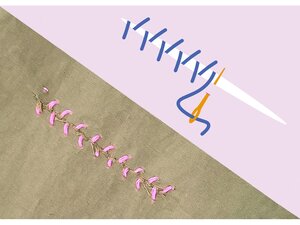
Tutorial: Baseball Stitch on a Tear
The baseball stitch gets its name from the iconic red seams on a baseball. It is perfect for closing a slit or tear in the middle of fabric when there has been minimal fabric loss.
Buttons
Buttons are one of the most common repairs. These tutorials will show you two techniques for sewing on buttons, each suited to different fabric weights.
Buttons on Thin Fabric

Tutorial: Sew a Button
This guide shows how to sew a button onto a lightweight shirt using tight, clean stitches.
Buttons on Thick Fabric

Tutorial: Sew a Button onto Heavy Fabric
This guide shows how to sew a button onto heavy work pants using a technique that creates a shank—a small thread post that lifts the button, allowing thick fabric to pass underneath.
Patches
Now you'll learn about patches and a few techniques for attaching them!
Making a Fabric Patch

Tutorial: Make a Fabric Patch
This guide walks you through choosing the right fabric and creating a patch for hand or machine sewn repairs.
Whip Stitch on a Patch

Tutorial: Whip Stitch on a Patch
Use the whip stitch you learned earlier to attach a fabric patch over worn areas or holes.
Blanket Stitch on a Patch

Tutorial: Blanket Stitch on a Patch
Secure a patch with a blanket stitch. Known for its durability and decorative appeal, blanket stitch is commonly used to secure raw fabric edges or attach patches.
Darning
Woven darning is a repair technique that weaves together threads or yarns to create a small patch. It’s ideal for small holes or worn areas where fibers are missing and the fabric needs to be rebuilt or reinforced. While it’s a woven method, it can be used on both woven and knit garments!
Woven Darning on a Knit

Tutorial: Woven Darn a Hole in a Knit
This guide demonstrates surface darning by weaving yarns across a hole in a wool sweater. This technique is ideal for small to medium sized holes in knits.
Woven Darning With a Speedy Weave

Tutorial: Woven Darning With a Speedy Weave
Use a Speedy Weave tool to organize your threads and streamline the woven darning process.



2 Comments
Thank you for this guide. Sewing and knitting are personal pleasures of mine since childhood. This guide can lead others into similar experiences.
These activities provided satisfaction: a sense of being helpful, a means of saving money, saving a beloved item, and a way to avoid wastefulness. They staved off boredom and provided escape. They stimulated creativity and discovery. I learned about fabrics and clothing construction. I picked up technique from elders, and learned by mistakes. My instruction was limited and superficial. i actively sewed from pre-teen days to grad school time. Work and family and lack of downtime has limited my sewing, but in my 70’s I hope to return to it with more instruction and guidance from experts with experience.
Katy - Reply Share
Thank you so much for sharing this! Your story is inspiring and beautifully captures the joy and creativity that come from sewing and knitting. Wishing you all the best as you return to sewing in this exciting new chapter!
Clara Redwood - Reply Share