Free Shipping on Domestic Orders $75+

Reverse Osmosis Filter Reservoir Pressure

What you need

    1. Reverse Osmosis Filter Reservoir Pressure, Disconnect the water supply: step 1, image 1 of 1
      • Disconnect the filter from the main water supply

      • Typically this is a needle valve

      Ask FixBot

      Add Comment

    2. Reverse Osmosis Filter Reservoir Pressure, Open the main water valve: step 2, image 1 of 1
      • Open the main valve to release the pressure from the reservoir/bladder.

      • Leave this open until you are ready to repressurize the reservoir

      Ask FixBot

      Add Comment

    3. Reverse Osmosis Filter Reservoir Pressure, Connect air pump to the reservoir: step 3, image 1 of 1
      • Remove the cap from the Schrader valve (or other) and connect an air pump

      • Most reservoirs have a standard Schrader valve

      • For a standard Schrader valve, connect a bicycle air pump to the valve stem

      Ask FixBot

      Add Comment

      • Use the air pump to (Gently!) force all of the water from the reservoir

      • Be careful to not over pressurize the reservoir/bladder! This may damage the filter!

      • (Gently!) pump your air pump as the water is drained from the reservoir

      • Continue (Gently!) pumping, to ensure all of the water is emptied from the reservoir.

      • Easy rule of thumb: if your pump has a built-in pressure gauge, generally avoid more than 10 to 20 PSI

      Ask FixBot

      Add Comment

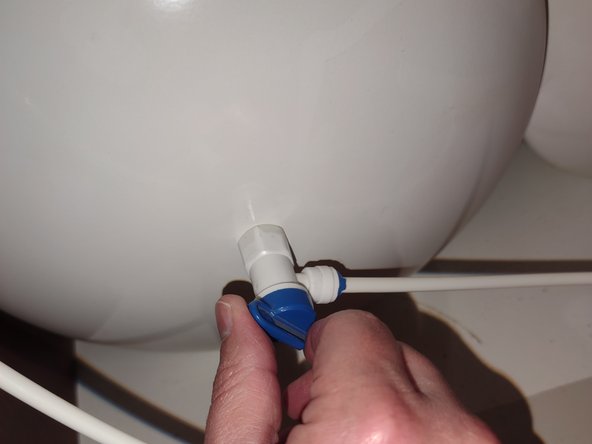
    4. Reverse Osmosis Filter Reservoir Pressure, Close the output valve of the reservoir: step 5, image 1 of 1
      • Close off the output valve for the reservoir

      • For most RO unit reservoirs, this is a ball valve on the top of the reservoir

      Ask FixBot

      Add Comment

      • Release any over-pressure of the reservoir

      • The reverse end of most tire pressure gauges, a flathead screwdriver, or your car keys, are good tools to easily release pressure from a standard Schrader valve

      Ask FixBot

      Add Comment

    5. Reverse Osmosis Filter Reservoir Pressure, Repressurize the reservoir: step 7, image 1 of 1
      • Use your air pump to repressure the, now empty, reservoir

      • Most reservoirs operate between 5 and 8 PSI

      • Consult the owners manual for your specific filter to find the optimum operating pressure for the reservoir

      Ask FixBot

      Add Comment

    6. Reverse Osmosis Filter Reservoir Pressure, Repopen the reservoir: step 8, image 1 of 1
      • With the reservoir repressurized to the specified pressure, reopen the ball valve

      • Fin.

      Ask FixBot

      Add Comment

Conclusion

Your reverse osmosis (RO) water pressure reservoir/bladder should now be repressurized!

Cancel: I did not complete this guide.

One other person completed this guide.

Daryl Metzler

Member since: 08/15/16

744 Reputation

1 Guide authored

Team

iFixit Member of iFixit

Staff

123 Members

82,818 Guides authored

0 Guide Comments

Add Comment

View Statistics:

Past 24 Hours: 5

Past 7 Days: 16

Past 30 Days: 105

All Time: 1,397