
How to Repair a Squeaky Couch

Blue Bryan and one other contributor
Last updated on Aug 14, 2026
Views: 637
View statistics:
- Past 24 Hours:
- 13
- Past 7 Days:
- 101
- Past 30 Days:
- 345
- All Time:
- 637
Comments: 0
No one has left comments on this guide. Will you be first?
Go to guide commentsCompleted: 0 1
No one has marked this guide "completed." Will you be the first?
1 person has marked this guide "completed." It's you — great job!
Favorites: 0 1
No one has favorited (and subscribed to) this guide. Will you be the first?
1 person has favorited (and subscribed to) this guide — and that's you!
Needs Better Images
Better photos will improve this guide. Help out by taking, editing, or uploading new ones!
Needs More Images
A few more images would make this guide's procedures crystal clear.
Introduction
Go to step 1 ↓A squeaky couch can be frustrating, especially when the noise occurs every time you sit down or change positions. In many cases, the squeak is caused by metal springs rubbing against one another or other components inside the couch. This problem can often be fixed with a few basic tools and a lubricant. This guide walks you through the steps to locate the source of the squeak, access the springs, and reduce or eliminate the noise so your couch is quiet and comfortable again.
Note: The techniques shown in this guide should work for most types of upholstered couches.
Caution: The couch may be heavy, so ask for help when moving or lifting it to avoid injury. To prevent stains, cover the surrounding area with a towel or rag in case excess lubricant drips from the contacts or springs.
What you need
Tools

-
-
-
Before you begin the repair, sit on the couch to identify the squeaky area.
 Ask FixBot
-
-
-
Carefully turn the couch over so the bottom is accessible.
-
Place it on a soft surface, such as a blanket or rug, to protect the upholstery.
-
-
-
Use an upholstery stapler remover tool to remove the staples securing the dust cover.
-
Peel the cover back only as much as needed to access the area where the squeak is occurring.
-
-
-
Apply a suitable lubricant directly to the squeaking springs and any contact points where metal parts rub together.
-
Move the springs slightly to help distribute the lubricant evenly.
-
-
-
-
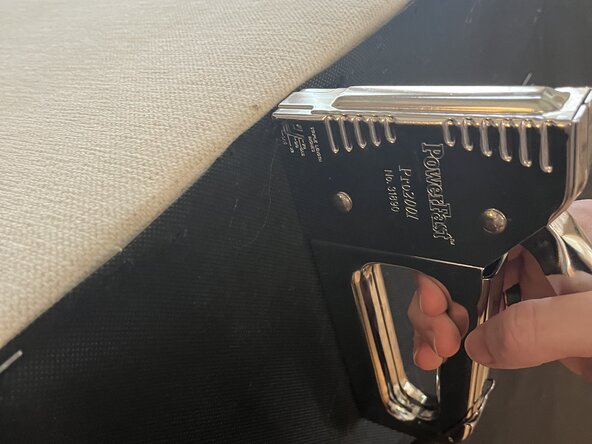
Pull the dust cover tight, align it with its original staple holes if possible, then secure it using an upholstery staple gun.
-
-




After completing these steps, test the couch to see if the squeaking has improved. While you may notice an immediate difference, keep in mind that the lubricant can take some time to fully work its way into the springs and contact points. In my personal experience, it took about 2–3 days for the squeaking to disappear completely. If the noise persists after a few days, inspect the couch again to make sure you've treated the correct springs or to check for any loose frame components that may also need attention.

Team

Austin Community College, Team A-3, Serna Summer 2026 Member of Austin Community College, Team A-3, Serna Summer 2026
AUSTINCC-SERNA-SU26SAG3
1 Member
12 Guides authored
